
5 October 2026
Main headlines
- Rhine Gridlock: Severe drought traps fuel oil at ARA ports, severing inland European supply ahead of winter.
- Asian Tightness: Persistent Persian Gulf transit friction and regional supply deficits restrict Singapore availability, supporting refining margins.
- Closed Arbitrage: High freight rates and cutter shortages block West-to-East trade, locking both regions in backwardation.
The Big Picture: ALKAGESTA Market Assessment
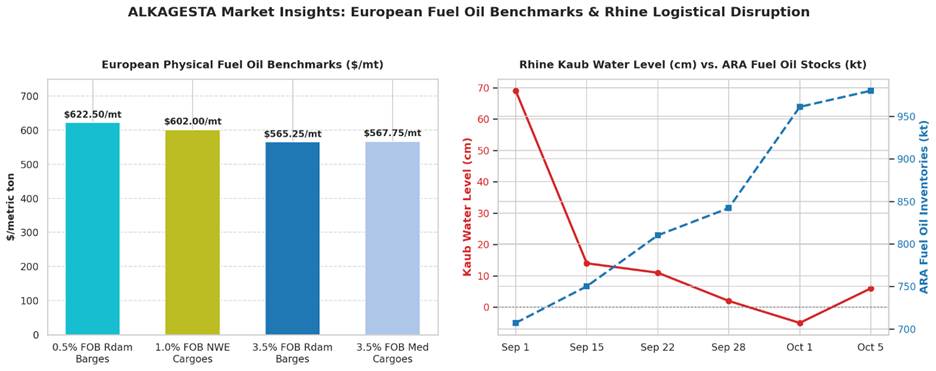
At ALKAGESTA, our desk observes the global fuel oil complex confronting an unprecedented dual-sided operational shock. On one side, severe hydrological drought along the Rhine River has paralyzed Upper Rhine barge navigation, with water levels at the critical Kaub chokepoint dropping to record lows of 0 cm on October 2 and negative readings down to -5 cm on October 1. This inland gridlock has forced major inland refining complexes, most notably Shell Rheinland (190 kb/d) and MiRO Karlsruhe (316 kb/d)—to reduce barge loadings by up to a third. Consequently, heavy refined products have accumulated at coastal ports, pushing Amsterdam-Rotterdam-Antwerp (ARA) fuel oil inventories up 18.5% week-over-week to 961,000 mt, compared with the 842,000 mt reported in the September 8 Fuel Oil Market Outlook, confirming the Rhine-ARA disconnect that report had flagged, even as inland European consumer markets face severe physical supply deficits entering the Q4 heating season.
Recent Market Developments: Refining Margins & Differentials
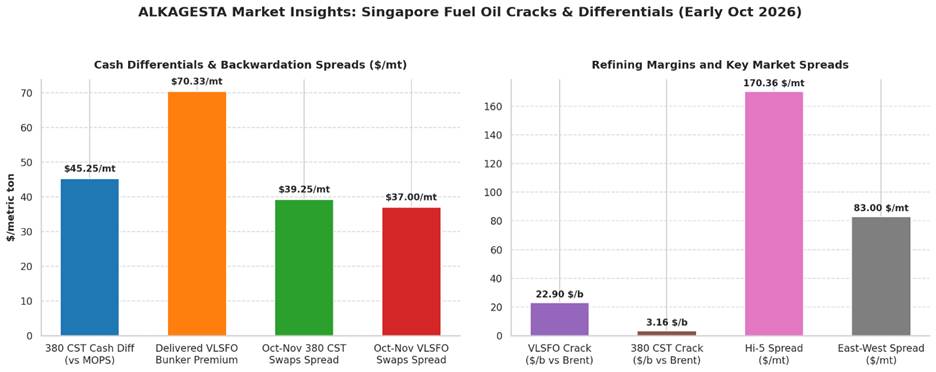
- Singapore VLSFO Refining Margin: The front-month Singapore 0.5%S Marine Fuel refining margin (crack) against ICE Brent stood at $22.90/b on October 2, maintaining strong structural profitability for low-sulfur refiners despite a minor 6% weekly easing. November forward cracks held firm at $23.15/b.
- Singapore HSFO Cash Premium Strength: The benchmark Singapore 380 CST HSFO cargo cash differential was assessed at a premium of $45.25/mt over MOPS on October 2 (up 50 cents/mt on the day), supported by intense physical MOC bidding from Shell, Sinopec, and Vitol.
- Singapore Backwardation Spreads: The Singapore 380 CST Oct-Nov swaps time spread backwardation held at $39.25/mt on October 5 (after touching $51.55/mt on October 1), while the 0.5% Marine Fuel Oct-Nov swaps spread was pegged at $37.00/mt.
- Singapore Bunker Premium Spike: Physical finished-grade VLSFO spot availability in Singapore experienced acute prompt tightness, driving the Singapore-delivered 0.5%S bunker premium up 24.3% week-over-week to a one-month high of $70.33/mt over cargo values.
- Key Inter-Product Spreads: The Singapore Hi-5 spread (VLSFO vs. HSFO) held at $170.36/mt, reflecting a balanced tightness across both sulfur pools. The East-West VLSFO spread stood at $83.00/mt, keeping the transatlantic and Europe-to-Asia arbitrage window closed for prompt loading.
- Record MOC Derivatives Volume: September Singapore fuel oil paper trading volume surged 65.8% month-over-month to 27.12 million barrels, driven by a 98.7% jump in HSFO swaps to 23.46 million barrels (the highest monthly volume since September 2022) and a 442% surge in 380 CST physical cargo deals to 1.025 million mt.
+
- European Physical Product Assessments: In Northwest Europe, 0.5% FOB Rotterdam Marine Fuel barges were assessed at $622.50/mt, while 3.5% FOB Rotterdam barges reached $565.25/mt and 3.5% FOB Med cargoes traded at $567.75/mt.
- 1.0% FOB NWE Cargo Assessment: In line with standard European trading practices, low-sulfur industrial fuel oil was assessed as 1.0% FOB NWE cargoes at $602.00/mt (with Rotterdam 1% barges valued in relation to 1% FOB NWE physical cargoes).
- Secondary Feedstock Pricing: Low-sulfur straight run (LSSR) FOB NWE cargo differentials held steady at $0.50/b to $2.00/b over M1 ICE Brent futures, reflecting steady demand for secondary refining feedstocks.
- Divergent Global Inventory Trends: Commercial fuel oil stocks in the ARA hub jumped 18.5% to 961,000 mt as of October 1 due to Rhine barge blockages, in contrast with ARA middle distillate inventories, which stood 25% below the five-year average at 2.108 million mt in the European ULSD Market Outlook. Conversely, Singapore onshore heavy distillate stocks fell 5.3% to a six-week low of 18.70 million barrels (week ended September 30), and Fujairah residual stocks plunged 30% week-over-week to 3.91 million barrels.
Singapore Hub: Fuel Oil Supply & Demand Analysis
Supply Dynamics
- Contracting Western Arbitrage Inflows: Arbitrage arrivals of low-sulfur marine fuel from Western hubs into Singapore are projected to fall to 1.5 million–1.6 million mt in October (down from 1.6 million–1.8 million mt in September), as elevated dirty tanker freight rates and narrow East-West spreads render prompt physical movements unviable.
- Regional Import Contraction: Although total fuel oil imports into Singapore reached 979,014 mt in the week ended September 30, arrivals from regional Asian producers dropped 26% week-over-week to 196,456 mt.
- Declining Outflows: Total fuel oil exports from Singapore fell 10% week-over-week to 360,522 mt in the week ended September 30, primarily driven by a 75% collapse in shipments to China to 29,997 mt.
Demand Dynamics
- Downstream Bunker Squeeze: The Singapore retail bunkering market experienced acute prompt finished-grade cargo availability constraints in early October, pushing delivered VLSFO premiums up to $70.33/mt over cargo values, reinforcing the Singapore Marine Fuels analysis, which identified availability rather than price as the main risk for bunker buyers.
- Robust Utility Burn for HSFO: High-sulfur fuel oil demand remains firmly supported by South Asian utility buyers (in Bangladesh, Sri Lanka, and Pakistan) substituting fuel oil for war-disrupted LNG imports. Pakistan’s domestic fuel oil exports fell 39% year-over-year in July-August as domestic refiners redirected heavy residual fuel to local power plants.
Europe (NWE & MED): Fuel Oil Supply & Demand Analysis
Supply Dynamics
- Inland Rhine Transportation Paralyzed: Water levels at the Kaub chokepoint hovered between 0 cm and 6 cm during October 1–5, halting Upper Rhine navigation and forcing inland refineries (Shell Rheinland and MiRO Karlsruhe) to slash barge loadings by up to a third.
- Trapped Coastal Stocks: Severe barge draft restrictions prevented product distribution to inland German and Swiss depots, accumulating 961,000 mt of fuel oil in ARA storage while depleting inland consumer inventories.
- Mediterranean Supply Divergence: Mediterranean VLSFO availability remains acutely dry due to limited prompt cargo offerings. In contrast, the regional HSFO pool was supported by steady arrivals from South and Central America.
- 1.0% FOB NWE Cargo Stability: The 1.0% FOB NWE cargo market saw steady pricing at $602.00/mt, with utility and industrial buyers absorbing available low-sulfur volumes.
Demand Dynamics
- Inland Winter Heating Squeeze: European inland heating oil and fuel oil demand is expanding ahead of winter, but severe Rhine logistical bottlenecks drove Swiss heating oil costs up 8% month-over-month in September to their highest level since 2022.
- Muted ARA Spot Bunkering: In the ARA retail bunker market, elevated flat prices and Rhine navigation hurdles disincentivized spot buying, leading to quiet trading activity despite tight prompt barge availability.
Strategic Outlook
- Rhine-ARA Structural Price Disconnect: European market dynamics will be dictated by the prolonged Rhine navigational crisis. With water levels at Kaub expected to remain in single digits, substituting barge flows with road transport would require an unachievable 3,000 additional road tankers daily. Consequently, ARA coastal stocks will remain trapped and depressed, while inland barge and depot prices trade in steep backwardation.
- Tight Asian LSFO Pending H2 October Inflows: Singapore VLSFO availability will remain constrained through the first half of October as reduced Western arbitrage arrivals (1.5M–1.6M mt) keep prompt finished-grade supplies tight, maintaining elevated delivered bunker premiums until component inflows recover in late October.
- Sustained HSFO Crack Strength via Utility Switching: High-sulfur fuel oil will continue to exhibit structural market strength across both Asian and European hubs, underpinned by persistent Persian Gulf crude/feedstock transit friction and robust South Asian utility burn to offset ongoing global LNG scarcity.
Disclaimer
This insight reflects Alkagesta’s views on historical developments and potential future trends in energy markets, demand, and supply dynamics. The analysis is based on Alkagesta’s internal assessments and publicly available information from a variety of external sources. Certain numerical data referenced in this insight is derived from or informed by information published by S&P Global Platts, including the Platts Long-Term Oil Demand Outlook.
This insight may contain forward-looking statements, including projections, expectations, estimates, and assumptions regarding future developments. Actual outcomes may differ materially from those expressed or implied due to a range of factors beyond Alkagesta’s control, including changes in economic conditions, technological developments, regulatory or policy changes, geopolitical events, shifts in energy demand and supply, or other market developments.
The information provided is for general informational purposes only. While Alkagesta believes the information is derived from reliable sources, no representation or warranty is made regarding its accuracy or completeness. Alkagesta assumes no obligation to update or revise any statements or information contained herein.
Any reference to or use of information contained in this insight should be accompanied by an appropriate citation of Alkagesta Market Insights and a link to the original publication.